
The Conventional Wisdom That Breaks First
Most 2026 marketing budgets rest on a quiet assumption: good SEO work carries over into AI search performance. If content ranks well, AI engines find it. If the domain has authority, citations follow.
That logic breaks in ways that are easy to miss.
AI search and SEO systems score content on overlapping but separate signals. Traditional search engines reward positional authority, link volume, and on-page optimization. Generative engine optimization rewards topical depth, structured answers, source credibility, and content format, specifically whether it can be pulled out and summarized accurately.
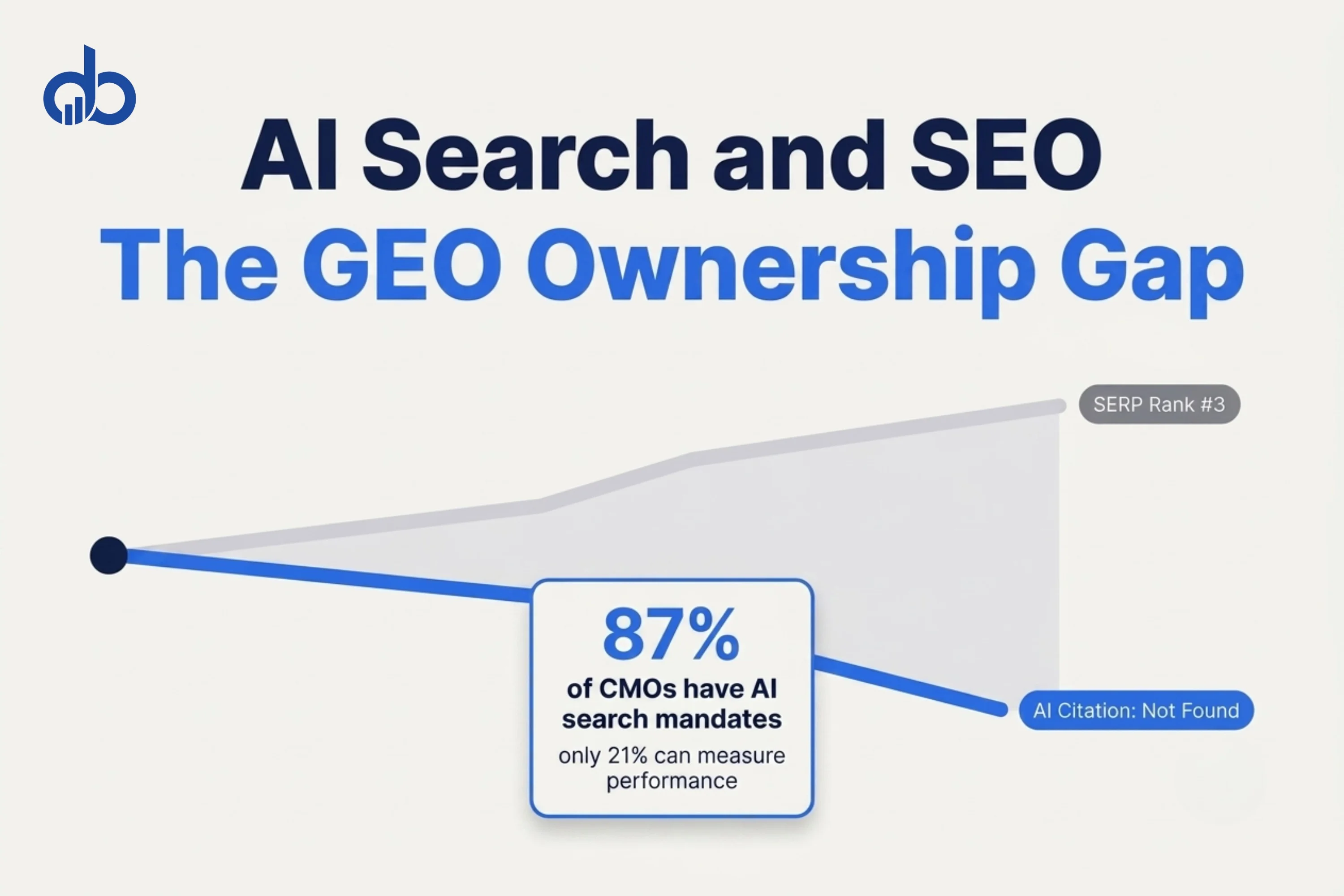
A page sitting in position three for a target keyword can be completely absent from AI-generated answers on that same query. Pages ranked outside the top 20 get cited in AI answers regularly because they have precisely structured, authoritative content that extracts cleanly.
The assumption that AI search and SEO results map to each other is already producing blind spots across B2B marketing. Those blind spots do not show up in the standard dashboard.
Where the Accountability Gap Actually Lives
Here is the number every CMO should have in front of them. A Forbes Business Council survey from June 2026 found that 87% of CMOs have board-level mandates to improve AI search performance. Only 21% have defined operational practices to measure or improve it.
Sixty-six percentage points separate expectation from execution. That is not a capability gap. It is an accountability vacuum.
The problem sits in three places.
Measurement does not exist. There is no standard GEO visibility metric equivalent to keyword ranking or organic traffic. Teams measure what they have always measured. Google Analytics and most SEO platforms do not track citation presence in AI-generated answers. No metric means no visibility into actual position.
Agency contracts have no GEO requirements. Pull out your current SEO or content agency contract. Does the statement of work include AI citation reporting as a deliverable? Almost certainly not. Across the industry right now, agencies are relabeling existing SEO services as generative engine optimization without changing a thing they actually do. The invoice says GEO. The work is the same content calendar from three years ago.
No one owns the outcome. If someone walked into your next leadership meeting and asked “Who is accountable for our brand’s AI search visibility?” could your team name a person? At most companies, the honest answer is no. GEO ownership gets assumed to be shared between content, SEO, and sometimes PR. Shared accountability with no named owner is not accountability at all.
When no one owns AI search visibility, no one is accountable when it disappears. For many B2B brands, it already has.
Not sure how visible your brand is in AI-generated answers? Get Free Marketing Audit
What the Data Actually Shows
The traffic data is sending a signal most teams are not reading correctly.
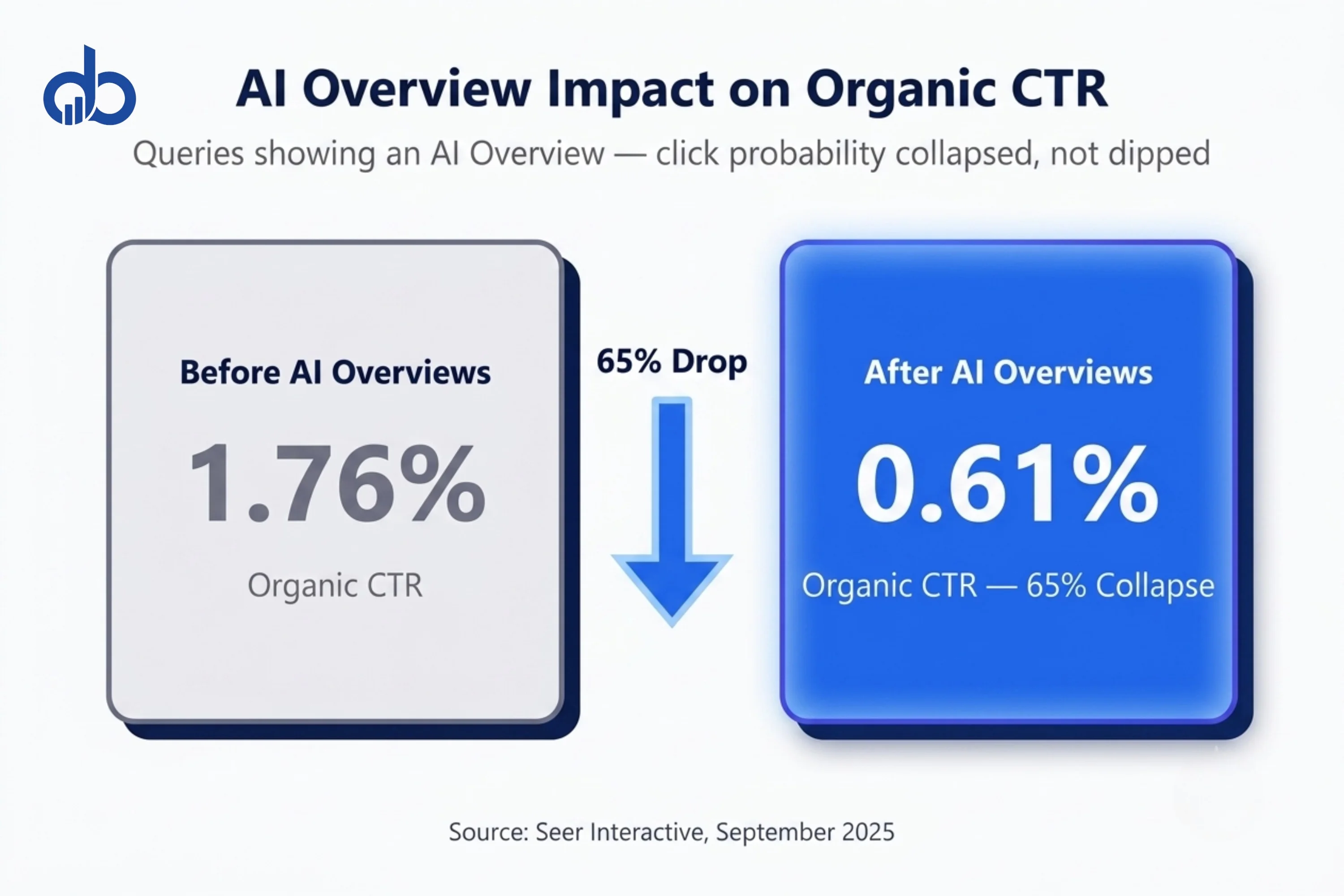
Organic click-through rates on queries where Google shows an AI Overview dropped from 1.76% to 0.61%, according to Seer Interactive’s September 2025 analysis. That is a 65% collapse in click probability on affected queries. Not a dip. A collapse.
Ahrefs tracked a 58% click reduction tied to AI Overviews across a broad query sample. Gartner forecast a 25% search volume decline by 2026 back in early 2024. That shift is now happening, but it is invisible to most reporting setups.
Here is why: at the aggregate level, traffic looks flat. The substitution is happening inside AI-assisted conversations that never send referral data to Google Analytics. The CMO sees a flat organic traffic line month over month. What the dashboard does not show is how much of the target audience stopped using Google entirely for certain queries.
AI search and SEO are diverging along a clean fault line. The brands showing up in AI-generated answers are not the same brands that dominate traditional rankings. The ones assuming SERP position is still the protection it used to be are measuring the wrong thing.
SEO for AI search is not an upgrade to your current practice. It is a parallel accountability surface most teams have not opened.
The GEO Visibility Ownership Stack
A Framework for Assigning Real Accountability
The GEO Visibility Ownership Stack is a three-layer model for assigning clear ownership of AI search visibility inside a marketing organization. Each layer has a defined owner, a set of measurable signals, and a reporting cadence. Without all three layers assigned, AI search optimization is a shared assumption, not a managed function.
Layer 1: Owned Signals
This is the layer most teams have, at least partially.
Owned signals are what your team controls: content structure, schema markup, topical depth, internal authority clustering, and how specifically your content answers buyer questions. This layer is where GEO optimization begins, and where it most closely mirrors traditional SEO work.
The work of SEO for AI search optimization starts here, with the content signals your team controls and can audit directly.
Owner: Content and SEO team
Measures: Manual AI citation audits (monthly), structured data coverage, topical cluster completeness, answer extractability
Reporting cadence: Monthly citation audit against target keyword list
The key difference from standard SEO practice: the metric is not ranking position. It is whether your content shows up in AI-generated answers when an engine processes your target queries.
Layer 2: Earned Citations
This layer measures how external authority signals translate into AI citation.
Backlink volume still matters, but what matters more for generative engine optimization is citation presence in AI-generated answers, not just link presence in Google’s index. A brand mentioned consistently in credible trade publications is more likely to surface in AI answers because those publications are heavily weighted source material.
Owner: Digital PR and link acquisition team
Measures: Brand mention monitoring in AI-answer audits, inbound citation quality, third-party coverage in AI-cited sources
Reporting cadence: Quarterly AI brand mention audit
This layer is where GEO optimization splits hardest from traditional SEO work. The goal is not link count. It is citation probability in AI answers.
Layer 3: Untracked Reach
This is the layer no one owns yet.
Untracked reach is where AI engines cite your brand in zero-click conversations: chat interfaces, voice answers, AI-assisted tools, and AI summaries in productivity software. There is no platform-native analytics for this reach. It does not appear in any standard marketing report.
Owner: Currently unassigned at most organizations
Action required: Name an owner. Build a quarterly manual audit. Add AI visibility to board-level dashboards.
Most B2B teams have Layers 1 and 2 in some form. Layer 3 is a blank. The organizations taking AI search optimization seriously in 2026 name a Layer 3 owner before a perfect measurement system exists. They do not wait for complete data before assigning accountability.
What This Means for Your Marketing Team
The board mandate is not going to close itself. GEO optimization requires named owners, defined metrics, and honest contract terms. That is a management decision, not a software purchase.
Here is the checklist for 2026.
Assign owners before the next budget cycle. Map your team against the GEO Visibility Ownership Stack. Identify who covers Layer 1, Layer 2, and Layer 3. If Layer 3 is unassigned, start there.
Build a citation audit into your reporting calendar. Monthly is the right starting cadence. No expensive software needed: query AI engines with your top 10 target keywords and the most common questions your buyers ask. Log when your brand appears, where it appears, and what source gets cited. That log is your baseline.
Review your agency contracts now. If your SEO or content agency cannot produce AI citation data, that is a gap in the engagement. Add an AI visibility reporting requirement to the next renewal. If they cannot fulfill it, you now know what they have actually been delivering.
Do not accept the label without the metric. When an agency says they are running generative engine optimization on your behalf, ask to see the citation audit. Ask which AI engines they track. Ask what happens when your citation rate drops. Vague answers mean vague work.
The companies moving from AI search anxiety to AI search ownership are not doing it with better tools. They are doing it by naming the problem and assigning someone to own it.
AI search and SEO are no longer the same function on the same metric. The teams that understand this distinction now will have 12 months of citation data before competitors start asking the same questions in 2027.
Want a GEO ownership review before your next budget cycle? Request a Proposal
- Good SEO rankings do not automatically translate to AI search visibility — the signals governing each are overlapping but distinct
- 87% of CMOs have board-level GEO mandates but only 21% have operational practices to measure or improve AI citation performance
- Pages outside Google's top 20 regularly earn AI Overview citations because structured, authoritative content extracts more cleanly than ranked pages
- Organic CTR on queries that trigger AI Overviews dropped from 1.76% to 0.61% — a 65% collapse in click probability on affected queries
- The GEO Visibility Ownership Stack has three layers: Owned Signals, Earned Citations, and Untracked Reach — most teams have only partially built the first two
- Layer 3 (AI citations in zero-click conversations and AI tools) is unassigned at most organizations — naming an owner is the first step
Frequently Asked Questions
What is the difference between GEO and SEO?
SEO targets ranking in traditional search engine results pages. Generative engine optimization (GEO) targets citation and visibility inside AI-generated answers, including Google AI Overviews, ChatGPT, Perplexity, and Gemini. The signals that drive each differ, and a page that ranks well in Google may be invisible in AI answers on the same query.
How do I know if my brand is being cited in AI search results?
There is no native analytics integration for AI citation tracking yet. The current best practice is structured manual audits: query AI engines with your target keywords and buyer-persona questions, then log when and how your brand appears. Some third-party tools are building citation monitoring, but coverage remains incomplete.
Is traditional SEO still worth investing in?
Yes. Strong organic rankings remain a prerequisite for AI citation. AI engines pull from authoritative indexed content. The change is that ranking alone no longer guarantees traffic. Teams need to optimize for citation probability in AI answers alongside SERP position.
Why is GEO a higher risk for B2B than B2C companies?
B2B buyers research more thoroughly before contacting vendors. A growing share of that research now happens inside AI-assisted conversations rather than keyword searches. If your brand is absent from AI-generated answers to your buyers' strategic questions, you miss the awareness stage entirely. That gap is often invisible for months before anyone realizes it is happening.