
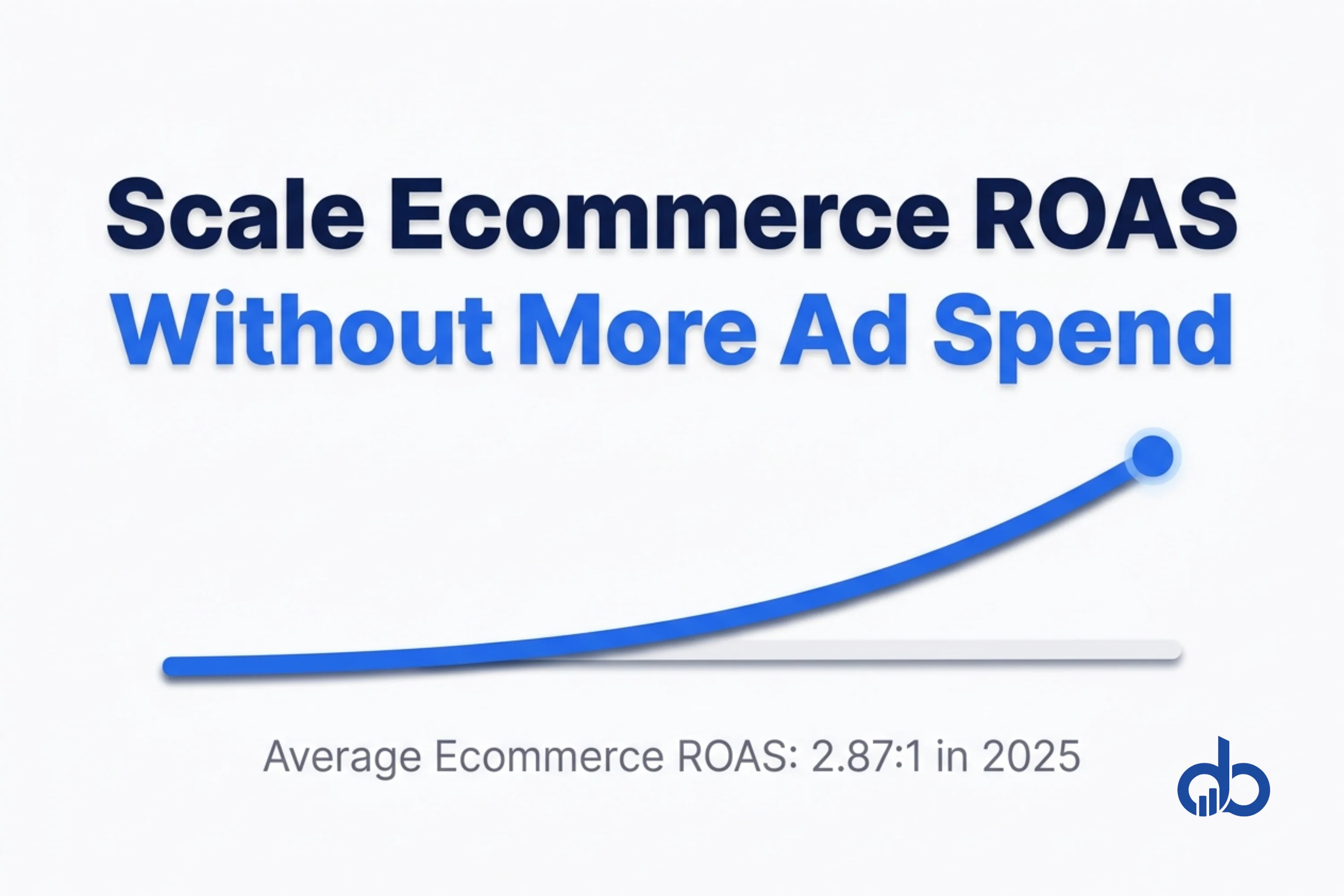
The average ecommerce brand generates $2.87 for every dollar spent on ads. The top 10% of performers generate over $13 from the same dollar. That’s a 4.5x ROAS gap between the median and the top, on identical ad platforms, in the same auctions, often selling in the same categories.
When ROAS stalls, the standard response is to spend more. Broader audiences, higher bids, more campaigns. It rarely works. The median brand is already operating near its breakeven ROAS, meaning every additional dollar spent without fixing the underlying system generates near-zero net return. More spend applied to a broken efficiency layer produces more waste, not more revenue.
The brands in the top decile aren’t spending more. They’ve changed what happens after the click. There are five specific levers they use, none of them inside the ad platform and the order they apply them in is the reason their ROAS compounds while everyone else plateaus.
What You Need Before You Start: Rethinking ROAS as a System Output
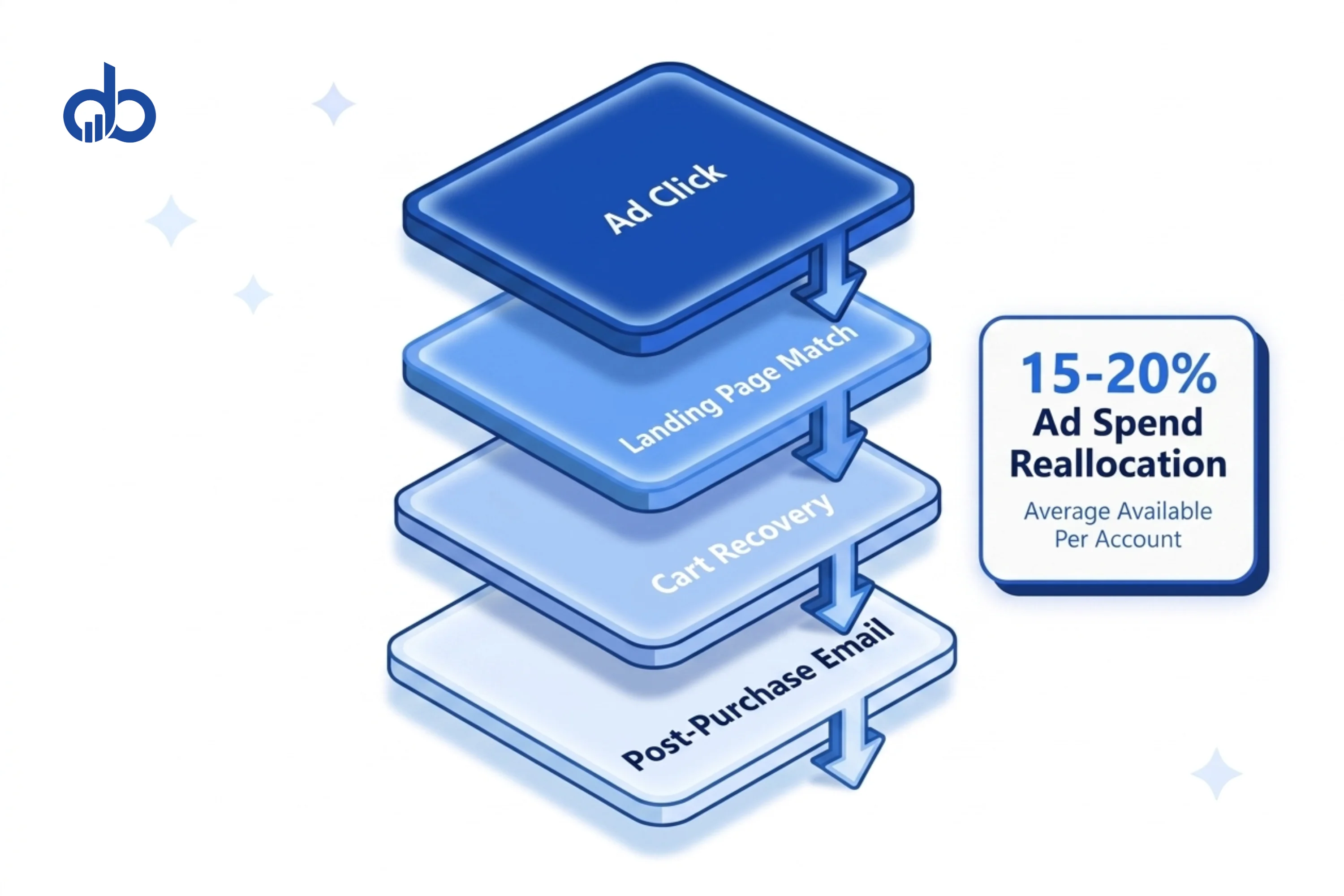
Most ecommerce brands look for ROAS improvements in three places: audience targeting, bid strategy, and ad creative. These are the levers the ad platforms make visible, so they get most of the attention. But the ad platform only controls what happens before the click. What happens after the click determines whether that click converts. That post-click window is where most ecommerce ROAS actually bleeds out.
ROAS is calculated as revenue divided by ad spend. You can grow it in two ways: spend less for the same revenue, or generate more revenue from the same spend. Off-platform optimizations do the second without touching the first. They apply to every click you’re already buying.
Before working through the five steps below, confirm these four things are in place:
Implementation Readiness Checklist:
- Purchase events are firing correctly in Google Analytics 4 or your attribution platform
- Your email platform is connected to your store and can segment by behavior (cart abandoned, purchased, browsed a specific product)
- You can create or edit landing pages independently of your homepage
- You have your gross margin percentage available (you’ll need it to calculate breakeven ROAS in Step 1)
Here's where it gets interesting. This off-platform approach requires real operational lift. Building email sequences, creating dedicated landing pages, and configuring upsell flows takes time and technical setup. Brands with very small email lists or high product complexity will see slower initial gains. The steps below are ordered by speed of impact, fastest wins first.
Before starting any ROAS optimization, run a 30-day attribution audit. Pull your GA4 data and identify which campaigns are actually driving conversions versus which ones are claiming credit for conversions initiated by other touchpoints. Most accounts have 15-20% of spend on campaigns that look productive in platform reporting but contribute little to actual revenue. Reallocating that spend to confirmed converters is the fastest ROAS improvement available. It requires no off-platform work at all.
Step 1 — Calculate Your True Breakeven ROAS
You can’t optimize toward a ROAS target until you know what target actually makes you money. Most ecommerce brands use benchmarks like “4x is good” without checking whether 4x is profitable for their specific margin structure.
The breakeven ROAS formula: Breakeven ROAS = 1 / Gross Margin Percentage
A brand with a 35% gross margin needs a 2.86:1 ROAS to break even on ad spend (before overhead, fulfillment, and returns). The average ecommerce ROAS is 2.87:1. That means the average brand is running near breakeven on every ad dollar. No room for margin on any other cost.
Complete this calculation before doing anything else:
- Pull your gross margin percentage for the last 90 days (revenue minus COGS, divided by revenue)
- Calculate your breakeven ROAS: 1 divided by your gross margin percentage
- Compare to your current reported ROAS
- Set your target at 20-30% above breakeven. This is the minimum profitable baseline.
This step isn’t optional. An ecommerce brand with a 25% margin needs a 4:1 ROAS to break even. Running at 3.5:1 while reporting “strong ROAS” means every ad dollar is generating a loss after costs. The steps below only generate real value if you know the margin they’re protecting.
Understanding this distinction is the foundation for everything in this guide. Many brands that come to our Performance Marketing team for ROAS help discover in the first session that their reported ROAS looked fine on paper. But once returns and fulfillment costs were factored in, they were operating below breakeven.
Include return rates in your margin calculation. A fashion brand with a 30% return rate has an effective gross margin 5-10 percentage points lower than its headline margin. High-return categories (apparel, footwear, home decor) often need a breakeven ROAS 1-2 points higher than the raw calculation suggests.
Not sure where your ecommerce ROAS is actually bleeding? Get Free Marketing Audit
Step 2 — Fix Your Landing Page Message Match
Message match is the alignment between what your ad promises and what your landing page delivers. When someone clicks an ad for “waterproof hiking boots under $150” and lands on a general footwear homepage, that match is broken. The click already cost you money. The conversion is now at risk.
Dedicated landing pages that mirror ad messaging (same product, same offer, same headline language) outperform homepage traffic by a wide margin. Unbounce data shows ecommerce pages in the top quartile convert at 11.4%, versus a 4.2% median. That gap is largely a message match problem.
Three specific fixes:
1. Headline alignment
The first headline on your landing page should echo the language of your ad. If your ad headline says “Free shipping on orders over $75,” your landing page should reference the same offer in the first 200 pixels. Not close to it. Exactly it.
2. Product specificity
Don’t send ad traffic to a category page if you can avoid it. An ad for a specific product should land on that product page or a dedicated campaign page. Every additional navigation step after the click reduces conversion probability.
3. Proof at the decision point
Reviews and social proof should appear near the add-to-cart button, not buried at the bottom of the page. Customers making a purchase decision need validation at the moment of commitment.
If your current ads send traffic to your homepage or a broad category page, building one dedicated landing page for your highest-spend campaign will produce a measurable ROAS improvement. You won’t need to change a single setting in your ad account.
An ecommerce client in the home goods category came to our Performance Marketing team with a 2.1:1 ROAS on their Meta campaigns. All paid traffic was landing on the homepage. After building three dedicated product-specific landing pages matching their ad creative, their reported ROAS moved to 3.4:1 within six weeks. Same campaigns, same audiences, same daily budget.
Sound familiar? That’s the message match gap in action.
Step 3 — Increase Average Order Value Without Adding New Traffic
When your average order value (AOV) goes up, your revenue per click goes up. Your ad spend stays flat. ROAS improves automatically.
The math is straightforward. You spend $1,000 on ads, drive 100 sessions at a 2% conversion rate, and generate 2 orders. At $80 AOV, your revenue is $160. That’s a 0.16:1 ROAS. Deeply unprofitable. But at $150 AOV, those same 100 sessions generate $300 in revenue. Your ROAS improvement came entirely from AOV, with no change to traffic or conversion rate.
Brands that implement upselling and cross-selling report up to 42% more revenue compared to those relying on single-item sales. Three approaches that actually work:
1. Pre-checkout upsell
Show a relevant complementary product on the product page or at the cart stage before checkout begins. This is an inline recommendation, not a popup. Keep the upsell product at or below 40% of the primary product’s price to stay within the impulse threshold.
2. Free shipping threshold
Set your free shipping threshold at 15-20% above your current AOV. A customer with $68 in their cart sees “Add $12 more for free shipping” and responds predictably. This is one of the lowest-effort AOV improvements available. No development work required beyond threshold configuration.
3. Post-add-to-cart upsell
Once a customer clicks “Add to Cart,” show one additional relevant product before they reach checkout. This catches customers at peak buying intent. The offer is presented at the moment they’ve already committed to buying, so acceptance rates tend to be well above the typical product page browse rate.
Don't stack more than two upsell offers in a single session. Three or more offers create decision fatigue and push up cart abandonment. One strong pre-checkout recommendation plus one free shipping threshold message. That's the ceiling for most ecommerce categories.
Step 4 — Build a Cart Recovery Sequence
70.22% of shoppers who add items to an ecommerce cart leave without buying. That’s not a platform problem. It’s not a targeting problem. It’s a follow-up problem.
A three-email cart recovery sequence is the highest-ROAS activity in ecommerce marketing. You’re re-engaging people who already expressed purchase intent. The ads already paid for that intent. Email recovers it at near-zero marginal cost.
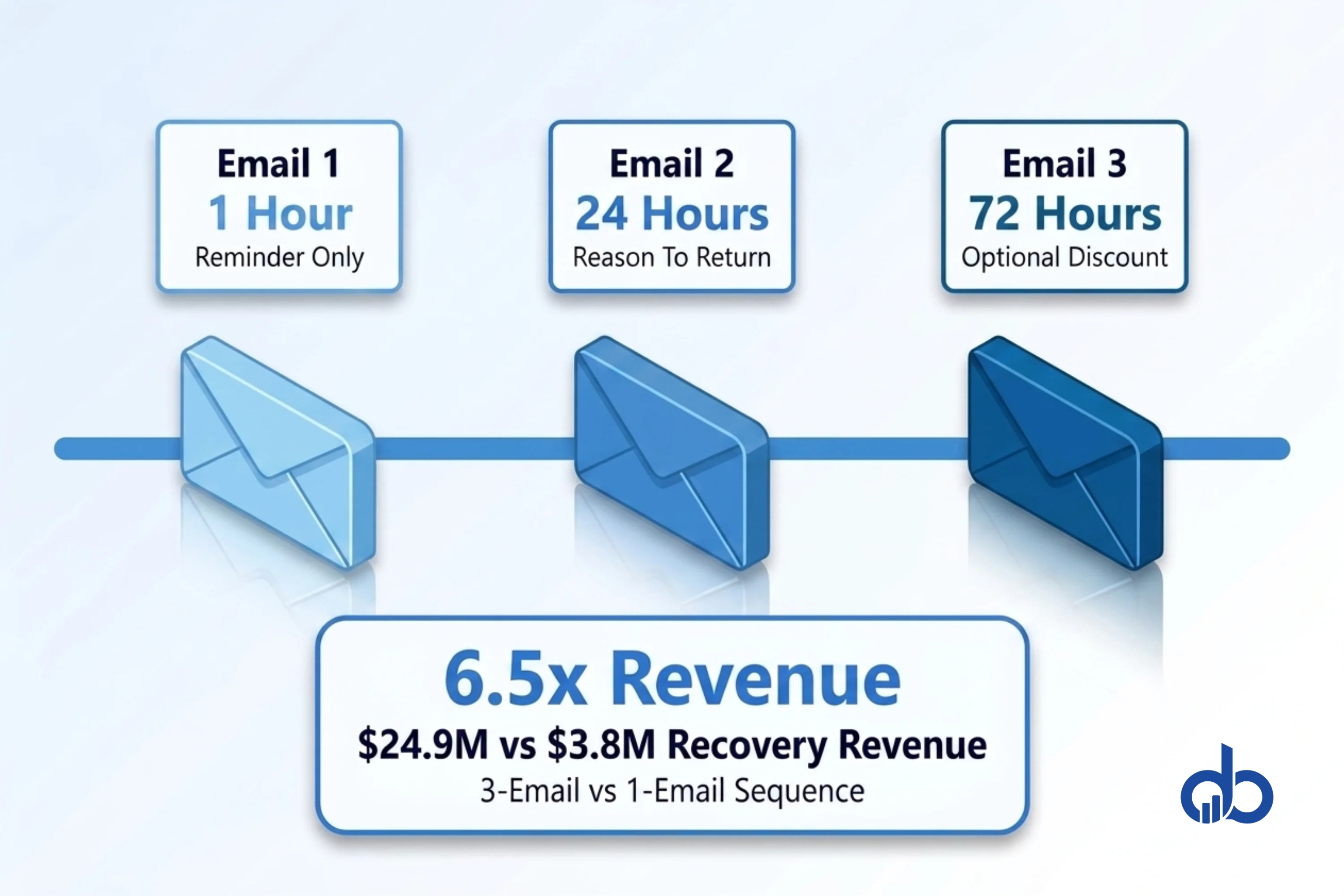
Campaigns using three cart abandonment emails generate $24.9 million in recovery revenue compared to $3.8 million from single-email campaigns. That’s a 6.5x revenue difference from sending two additional automated messages. Seriously. Two emails.
The sequence that works:
Email 1 — 1 hour after abandonment
Reminder only. No discount. “You left something behind” with a product image and a direct link back to the cart. Cart abandonment emails average a 39% open rate. This first send catches the highest-intent abandoners who left for a non-price reason: distraction, a payment issue, or a quick question they needed to look up.
Email 2 — 24 hours after abandonment
Add a specific reason to return. Not a discount. Try a feature emphasis, a customer review, or a scarcity signal like “only 3 left in stock.” Price-sensitive shoppers who didn’t return after Email 1 may respond to a different kind of nudge.
Email 3 — 72 hours after abandonment
If you choose to offer a discount, here’s where to do it. A 10-15% discount at the 72-hour mark converts the segment that wanted the product but needed a price bridge. But don’t put the discount in Email 1. That trains customers to abandon carts intentionally to wait for the offer. That erodes your margins permanently.
If you’re currently running a single-email sequence or a single broadcast for cart abandonment, upgrading to a three-email automated flow is the single fastest off-platform ROAS improvement you can make.
Step 5 — Activate Post-Purchase Email Revenue
Most ecommerce brands treat the purchase as the end of the revenue event. The paid click converted. The ROAS was captured. The campaign moves on.
But the customer who just bought from you is the highest-converting audience you have access to. They know your product. They have your payment method saved. They’ve already proved willingness to spend. Email marketing delivers an average of $42 for every $1 spent across all industries. Retail and ecommerce segments reach 45:1.
Three post-purchase sequences that generate incremental ROAS from traffic you already paid for:
1. Cross-sell sequence (Day 7-14 post-purchase)
Based on what the customer bought, surface the most relevant complementary product. This isn’t a generic “you might also like.” It’s a sequenced recommendation that makes sense given their specific purchase. A customer who bought a yoga mat should get an email about yoga blocks, a strap, or a bag, not random bestsellers from your catalog.
2. Replenishment trigger (Category-dependent)
For consumables (supplements, skincare, coffee, pet food), a replenishment email at the product’s expected depletion window (30, 60, or 90 days) converts at rates that cold acquisition advertising can’t match. The customer already chose your brand once. The replenishment trigger is a reminder, not a pitch.
3. Win-back sequence (60-90 days post-purchase)
Customers who haven’t purchased again within 60-90 days are at risk of lapsing. A win-back sequence with a mild incentive reactivates them before they go cold. The cost per conversion is far below what paid ads charge for a new customer.
Every dollar these sequences generate improves your blended ROAS (total revenue divided by total ad spend across your full marketing mix) without a single additional ad impression.
Running paid ads without a post-purchase email stack means leaving ecommerce revenue on the table every day. And if your Analytics & Tracking setup doesn’t yet feed behavioral triggers to your email platform, that’s the first integration to fix.
Ready to build the full ecommerce revenue stack alongside your campaigns? Request a Proposal
Common Mistakes That Kill ROAS Improvements
Even with the right framework, most ecommerce brands repeat the same mistakes when they start optimizing off-platform. Here’s what to watch for.
Mistake 1 — Changing the ad account while fixing off-platform issues
When you rebuild landing pages and launch a cart recovery sequence at the same time, you lose the ability to attribute ROAS changes to specific levers. Run one change at a time for at least 14 days before adding the next. Clean data leads to correct decisions.
Mistake 2 — Measuring ROAS at the campaign level instead of the blended level
A cart recovery email doesn’t show up as ad ROAS. It shows up as email revenue. If you’re only measuring ROAS in your ad account, you won’t see the full impact of off-platform improvements. Your Marketing Efficiency Ratio (MER) is total revenue divided by total marketing spend including email platform fees. It’s a more accurate measure of whether your full conversion stack is working.
Mistake 3 — Sending all traffic to a homepage and calling it a landing page
Your homepage is designed for discovery. A landing page is designed for conversion. These are different jobs and they need different page structures. A homepage with a “Shop Now” button isn’t a landing page.
Mistake 4 — Putting a discount in the first cart abandonment email
Customers who receive a discount in Email 1 learn to abandon carts deliberately to wait for the offer. This erodes margins on every future transaction with that customer segment. Reserve discounts for the third touch.
Mistake 5 — Using platform-reported ROAS without an attribution check
Meta and Google both use attribution windows and modeled conversions that can overstate ROAS. On Facebook, retargeting campaigns average 3.61:1 ROAS while new customer acquisition averages 2.19:1, but the platform blends these into one reported number. Platform-reported ROAS may look better than actual revenue impact. Use an independent attribution platform or your direct revenue data to validate what the ad platform reports.
The Conversion Stack Is Where ROAS Is Won
Your ecommerce ROAS is within your control even if your media budget stays flat. The breakeven calculation shows you exactly what you’re protecting. The dedicated landing pages convert the traffic you already bought. The AOV improvements mean each click generates more revenue than it did yesterday. The cart recovery sequence recaptures intent that would otherwise evaporate. And the post-purchase emails generate ecommerce revenue increase without spend from customers you already acquired.
The gap between knowing these levers and building them. That’s where most brands get stuck. Each one is a real project: a page build, an email flow, a product configuration. Our Performance Marketing service builds and manages the full ecommerce conversion stack alongside your ad campaigns, so improvements compound rather than sit on a to-do list.
Want to know exactly where your ROAS is bleeding and what to fix first? Get Free Marketing Audit
- Your breakeven ROAS is 1 divided by your gross margin percentage — calculate it before applying any industry benchmark as a target
- Message match between ads and dedicated landing pages moved one client's ROAS from 2.1:1 to 3.4:1 with no ad account changes
- Increasing AOV raises ROAS proportionally — upselling and cross-selling report up to 42% more revenue from the same traffic
- Three-email cart recovery sequences generate 6.5x more revenue than single-email campaigns at near-zero marginal cost
- Post-purchase email sequences generate incremental revenue from customers you already paid to acquire, improving blended ROAS
- Measure Marketing Efficiency Ratio (total revenue divided by total marketing spend) not just platform ROAS to see the full picture
Frequently Asked Questions
What is a good ROAS for ecommerce?
For most ecommerce businesses, 4:1 is a healthy starting benchmark. But "good" depends entirely on your margins. A brand with a 20% net margin needs at least 5:1 to stay profitable after costs. Calculate your breakeven ROAS first (1 divided by your gross margin percentage) before you use any industry benchmark as a target.
Why does ROAS drop when I increase ad spend?
Because you exhaust your warmest, highest-intent audiences first. The first dollars of spend go to people already searching for what you sell, and they convert easily. Additional spend reaches lower-intent audiences who need more convincing, which drops average conversion rates and raises your effective CPC. This is normal and expected. The fix is deepening your conversion stack so lower-intent traffic converts at better rates.
How long does it take to see ROAS improvement from off-platform changes?
Landing page message match can show measurable results within 7-14 days as test data accumulates. Cart recovery sequences typically show results within the first 30 days. AOV improvements through upsells tend to compound over 60-90 days as you optimize offer positioning.
Can I improve ROAS without an email list?
Yes, but your toolkit is narrower. Focus on landing page optimization and AOV improvements first. Both work on the traffic you already have with no email infrastructure required. Build your list simultaneously through on-site pop-ups and post-purchase capture so that email-based recovery becomes available within 60-90 days.
Does improving ROAS require pausing my ads?
No. The off-platform improvements in this guide run in parallel with your active campaigns. You don't need to pause, reduce budgets, or change your ad account settings. In most cases, your reported ROAS will improve while the same campaigns run at the same spend, because more of that traffic is now converting.